

On rough ground, suspension geometry stops being a comfort question and becomes a survival question for the trailer and its cargo. The off-road leaf spring 8×60×830 is a heavy duty pack built for exactly that duty: more length, more stack thickness and more arch than a highway utility spring, so the axle can travel over ruts and rocks without the pack bottoming out on the frame. For agricultural, construction, mining-support and expedition trailers, that extra travel is the difference between arriving with the load intact and arriving with a bent axle. This article explains what the numbers mean and how to confirm the pack suits your running gear.
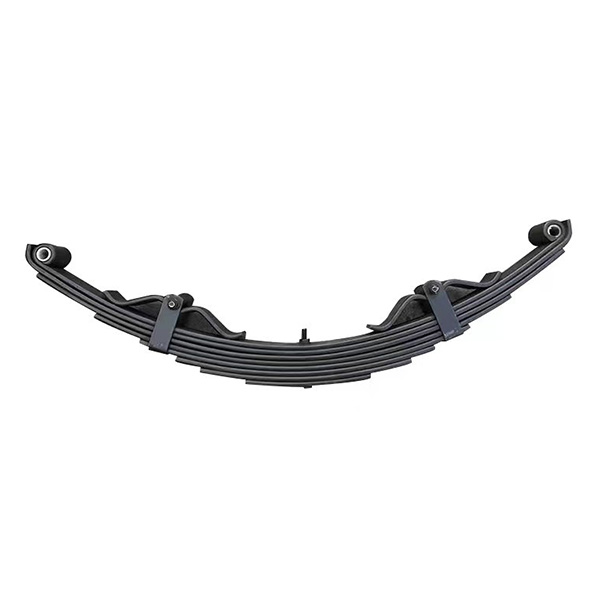
1. What the Numbers 8×60×830 Actually Mean
Reading the code correctly is the first step in any cross-reference. The three figures describe the physical envelope of the pack, and each one constrains a different part of the installation.
8 — nominal leaf width in mm; must match the axle spring seat and U-bolt spacing.
60 — nominal stack thickness in mm; a direct indicator of capacity and rate.
830 — length in mm; sets the hanger spacing and available shackle swing.
Compared with a lighter utility pack such as 7×60×800, the extra length and stack give a higher load rating and more controlled deflection. That is why the same nominal width can serve very different duties once thickness and length change.
2. Why Off-Road Springs Need More Arch and Travel
An off-road trailer does not meet bumps at a predictable angle. One wheel drops into a rut while the other climbs a rock, so the suspension needs reserve travel in both directions. Arch provides the compression reserve; the spring's length and rate determine how far the axle can droop before the U-bolts or shock mounts become the limit.
Arch height — keeps ride height when loaded and prevents contact with the frame
Longer eye-to-eye length — softer rate and greater travel for the same load
Higher leaf count or thicker stack — capacity without excessive sag
Controlled interleaf friction — damping that stabilises the trailer on uneven ground
Interleaf friction is often dismissed as a drawback. On rough ground it is useful: it damps oscillation and reduces the bouncing that loosens cargo and cracks welds.
3. Typical Applications
The off-road pack appears wherever a trailer is expected to work away from pavement. In each case the requirement is the same: carry the load, absorb the terrain, and keep the axle where it belongs.
Agricultural and farm trailers — field tracks, headlands and loaded grain carts.
Construction site trailers — compaction plant, generators and tool carriers on unprepared ground.
Mining and quarry support equipment — heavy, continuous shock loading.
Expedition and overland trailers — long distances on corrugated dirt roads.
Forestry and firewood haulage — soft, rutted ground with shifting loads.
4. Matching the Spring to Axle, Shackle and Load
A spring never works alone. Capacity, ride height and durability all depend on how well the pack matches the rest of the running gear.
| Component | What to confirm |
|---|---|
| Axle capacity | Spring rating covers the loaded axle, not the empty trailer |
| Spring seat | Width and centre position suit the pack |
| Shackle | Length and angle allow full travel without inversion |
| U-bolts | Correct diameter, grade and torque |
| Bushings | Material suits dust, mud and washdown exposure |
Over-specifying is not harmless either. A pack that is far too stiff for a light trailer transmits shock straight into the frame and cargo, and produces the bouncing that damages both.
5. Installation Checks and Service Notes
Most premature failures trace back to installation rather than to the spring itself. A short list of checks at fitting time prevents the majority of them.
Torque U-bolts to specification, then re-check after the first loaded trip
Confirm shackle angle at ride height leaves room to swing
Fit new bushings and hardware with a new pack
Check clearance between the spring and frame at full compression
Replace in axle pairs to keep the trailer level
During service, look for leaf fanning, a shifted centre bolt, cracked eyes and polished wear marks where a leaf has been contacting the frame. Each of these is an early warning that costs little to correct.
Frequently Asked Questions
Can an off-road spring be used on a highway trailer?
It can, but the ride will be firmer than a highway pack of the same capacity. Off-road springs prioritise travel and durability over comfort.
How do I measure arch correctly?
Measure from a straight line between the two eyes down to the top of the main leaf at the centre, on an unloaded spring resting on a flat surface. Compare that figure with the manufacturer's specification.
Do I need to upgrade the axle when fitting a heavier spring?
Not necessarily, but the spring rating should never exceed what the axle, hangers and frame are designed to carry. Check the axle rating first.
Is a galvanised finish available for off-road springs?
Yes. Hot-dip galvanizing is recommended where the trailer is washed down frequently or works in wet, muddy or salted conditions.