

Ordering the wrong leaf spring is one of the most common — and most expensive — mistakes trailer owners make. The two designs look similar but mount completely differently, and fitting a double eye spring where a single eye belongs (or vice versa) means drilled holes, misaligned axles, and a dangerous ride. This article compares double eye leaf spring and single eye leaf spring designs so you can identify and order the correct part the first time.
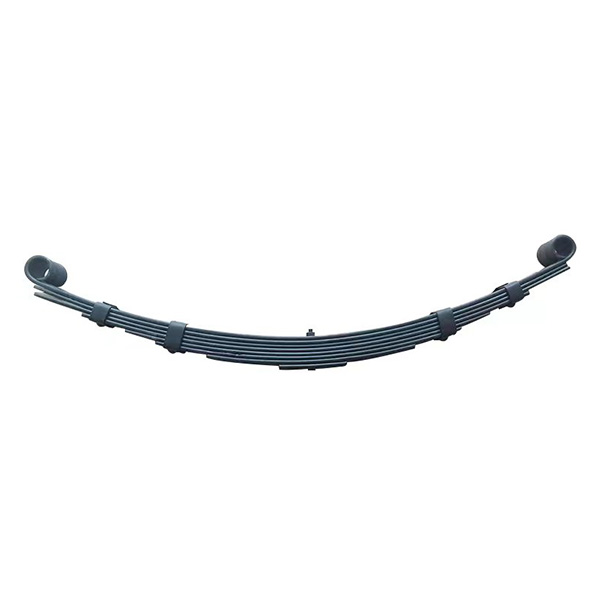
What Is a Double Eye Leaf Spring?
A double eye leaf spring has a circular eye formed at both ends of the master leaf. The front eye bolts to a fixed front hanger on the frame, while the rear eye connects to a shackle that pivots from a rear hanger. As the spring flexes and flattens, the shackle lets the rear end swing, keeping the ride height stable.
This is the most common trailer spring because it handles both compression and rebound smoothly and suits standard hanger kits found on utility, cargo, and boat trailers.
What Is a Single Eye Leaf Spring?
A single eye leaf spring — sometimes called a slipper or semi-elliptic spring — has one formed eye at the front and a flat, open "slipper" end at the rear. The front eye bolts to a fixed hanger, while the slipper end slides freely inside a rear hanger channel. There is no shackle; the spring lengthens by sliding rather than pivoting.
Single eye springs are popular on lighter trailers, older designs, and applications where a simpler, lower-cost suspension is preferred.
"The fastest way to tell them apart is to look at the back end. Two eyes means double eye; one eye and a flat tail means single eye or slipper." — Haoye Product Specialist
Side-by-Side Comparison
| Feature | Double Eye Leaf Spring | Single Eye Leaf Spring |
|---|---|---|
| End configuration | Eye at both ends | Eye at front, slipper at rear |
| Rear connection | Shackle pivot | Sliding hanger channel |
| Ride smoothness | Very good | Good, slightly firmer |
| Complexity | More parts (shackles) | Fewer parts |
| Typical use | Utility, cargo, boat trailers | Light trailers, vintage, simple designs |
| Replacement ease | Straightforward with kit | Simple, fewer bolts |
How to Identify Which One You Need
Before ordering, gather these measurements and observations:
Count the ends: Two eyes = double eye. One eye + flat tail = single eye.
Measure eye-to-eye: The unloaded distance between the centers of the eyes (for double eye) or eye center to slipper tip (for single eye).
Measure width: Across the leaves at the center bolt.
Count leaves and note arch: More leaves usually means higher capacity.
Check hanger geometry: Existing shackles indicate a double eye setup.
"Never order by capacity alone. Two springs with the same rating can have completely different eye types and won't interchange." — Haoye Suspension Engineering Team
Mounting Considerations
Double eye springs require a front hanger and a shackle-rear hanger, which adds slight complexity but improves articulation. Single eye springs need a front hanger and a slider channel; they are more compact but can shift slightly under hard braking. For most modern trailers, the double eye design is the safer, smoother default.
Capacity and Sizing Notes
Common light-trailer sizes include 8×45×700, 7×60×800, 8×45×641, and 9×45×950 (width × thickness × eye-to-eye in mm). The first number is leaf width, the second is thickness, and the third is length. Matching all three — plus the eye type — guarantees a bolt-in fit.
"Width, thickness, and length are non-negotiable. Get one wrong and the spring won't seat on the axle perch correctly, no matter how close the rating is." — Haoye Field Service Note
Frequently Asked Questions
Can I convert a single eye trailer to double eye?
Usually not without welding new hangers. The frame mounting points differ, so it is better to replace like-for-like unless you are rebuilding the suspension.
Which lasts longer, double or single eye?
Both last similarly when sized correctly. Double eye shackle bushings wear and need periodic checks; single eye slipper ends need clean slider channels.
Are the leaf counts the same between types?
Not necessarily. Capacity depends on leaf count, width, and thickness, independent of eye type.
Can I mix double and single eye on one trailer?
No. Both axles must use the same spring type and rating to keep the frame level and the load balanced.
Do eye bushings need replacing?
Yes. Worn bushings cause clunks and uneven wear. Replace them when you replace the spring for a like-new ride.
What if my old spring is rusted and unreadable?
Measure the mounting points and send photos to a manufacturer. A supplier like Haoye can cross-reference dimensions to the correct eye type.
Conclusion
Choosing between a double eye leaf spring and a single eye leaf spring comes down to your trailer's hanger geometry, not personal preference. Identify the eye type, match the three key dimensions, and you will get a safe, bolt-in replacement that restores proper ride height and load control.
Get the Exact Leaf Spring You Need
Renqiu Haoye Motorcycle Parts Co., Ltd. stocks and custom-builds both double eye and single eye leaf spring assemblies in standard and galvanized finishes. Send your dimensions or old spring photos and we will match the specification at factory-direct pricing. Visit Haoye Machinery to start your order.