

Comparing two quotations for jockey wheel assemblies on unit price alone almost always gives the wrong answer. This article follows the cost through fit-up hours, inspection, downtime, spares and eventual replacement, and shows where a modest specification margin pays for itself.
Purchase price is the small number
A clear, unambiguous specification helps everyone. State the grade, the governing dimensional standard, the interface geometry, the required inspection and the documentation, and leave the supplier in no doubt about which trailer jack is expected. Ambiguity at this stage is the most common source of a costly re-order.
Most specification mistakes are not dramatic. They come from assuming that a trailer jack rated for one duty will quietly cover a neighbouring application as well. In practice, a small change in static load rating, travel and wheel diameter can move the part outside its intended window, and the resulting rework is far more expensive than the original saving.
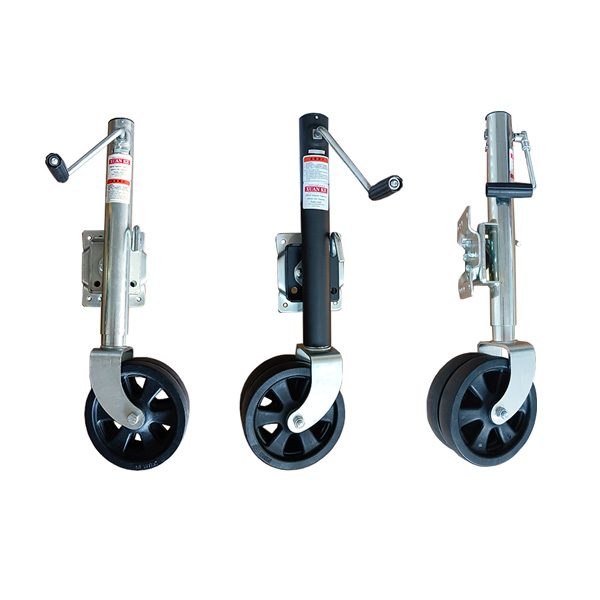
Where the real cost accumulates
Training the installation crew on the specific detail is more effective than issuing a generic procedure. When the fitter understands why clamp torque, tube straightness and wheel play matters, the check becomes part of the work rather than a box to be ticked afterwards, and the resulting consistency shows up clearly in inspection records.
| Cost element | Where it appears | How to control it |
|---|---|---|
| Purchase price | The quotation | Compare identical scope only |
| Fit-up hours | The workshop | Specify static load rating, travel and wheel diameter unambiguously |
| Rework | After inspection | Check clamp torque, tube straightness and wheel play before assembly starts |
| Downtime | During service | Choose a rating with a sensible margin |
| Spares holding | The stores | Standardise on a small family of jockey wheel assemblies |
| Replacement | End of service life | Keep the record with the build |
The reason engineers return to the trailer jack is simple: it solves a recurring load and geometry problem in a vehicle assembly with a part that can be manufactured repeatably, inspected easily and replaced without disturbing the rest of the structure. That combination is hard to beat on a busy build.
Downtime and access
- Documentation — Certificate, dimensional record and inspection report travel together.
- static load rating, travel and wheel diameter — State each value explicitly; ambiguity here is the most common source of a re-order.
- zinc-plated steel tube — Selected where corrosion, weight or temperature rules out the default.
- galvanised steel tube — The general-purpose choice; verify grade and traceability on the certificate.
- the load rating conventions for jockey wheels — Sets the dimensional envelope; confirm conformity on received parts.
Vibration is another quiet contributor to premature failure. Assemblies connected to rotating equipment carry a continuous low-amplitude load that a static design check will not capture. Adequate support spacing and a sensible clamp detail are usually enough to keep it under control. For hitching and unhitching on uneven ground, it is worth writing that check into the inspection plan instead of leaving it to habit.
Hidden line items
Cleanliness is easy to overlook on plain steel but critical on finished surfaces. Protecting the contact faces, keeping the bore free of debris, and capping open ends during assembly are simple habits that prevent damage which is otherwise discovered only at final fitting or commissioning. For hitching and unhitching on uneven ground, it is worth writing that check into the inspection plan instead of leaving it to habit.
Spares, standardisation and stock
One useful habit is to walk the assembly before it is closed up and look for anything that will be inaccessible later. A trailer jack positioned behind a panel or under a cover may be technically correct yet impossible to inspect, and that inaccessibility becomes a maintenance liability for the life of the vehicle.
- clamp torque, tube straightness and wheel play — A practical acceptance check at goods-in and again after fit-up.
- static load rating, travel and wheel diameter — State each value explicitly; ambiguity here is the most common source of a re-order.
- zinc-plated steel tube — Selected where corrosion, weight or temperature rules out the default.
- Documentation — Certificate, dimensional record and inspection report travel together.
- galvanised steel tube — The general-purpose choice; verify grade and traceability on the certificate.
In hitching and unhitching on uneven ground, the trailer jack usually sees a mix of steady load and short transients. Designing only for the steady case is a common shortcut; the transient case is what decides whether the assembly stays tight after a season of operation or begins to loosen.
Comparing two specifications honestly
Corrosion protection is easiest to specify and hardest to retrofit. Coatings, compatible isolation from dissimilar metals, and drainage that avoids trapped moisture all extend life. On enclosed assemblies, the risk often hides beneath cover panels, so inspection planning should include the areas that are not visible on a routine walk-around. For hitching and unhitching on uneven ground, it is worth writing that check into the inspection plan instead of leaving it to habit.
A sensible maintenance routine is built around observation rather than calendar-driven replacement. Recording clamp torque, tube straightness and wheel play at each inspection, noting any change in appearance, and comparing readings over time reveals a developing problem long before it becomes a failure or an unplanned stoppage.
What a modest margin buys
Troubleshooting usually starts with a short list of recurring causes. bent inner tube from side loading accounts for a large share of early failures, and it is frequently traced back to installation practice rather than to a defective part. Confirming the symptom before replacing anything avoids the expensive habit of changing components until the problem disappears.
| Criterion | single guide wheel | dual guide wheel |
|---|---|---|
| Layout | Needs a little more room around the joint | Fits a crowded assembly |
| Load path | Smoother transfer under steady duty | Handles compact installations |
| Material | galvanised steel tube normally specified | zinc-plated steel tube where the environment demands it |
| Fit-up | More alignment checks before assembly | Faster to position on the bench |
| Inspection | clamp torque, tube straightness and wheel play verified in two stages | clamp torque, tube straightness and wheel play verified at final fit |
| Typical use | Common on hitching and unhitching on uneven ground | Chosen where access is limited |
Reading the total
Writing the business case
- ✓ Dimensional check sheet attached to the build number
- ✓ Inspection and test reports signed off
- ✓ Any field deviation recorded with its reason
- ✓ Drawing revision identified unambiguously
- ✓ Handover copy passed to the maintenance team
- ✓ Trailer Jack service and static load rating, travel and wheel diameter confirmed against the duty rating