

If your trailer rides rough, sags under load, or develops an annoying squeak over every bump, the culprit is usually the suspension — and more often than not, the humble leaf spring. Despite being one of the oldest suspension designs in the automotive world, the leaf spring remains the backbone of heavy-duty and trailer applications because it is simple, strong, and remarkably cost-effective. This guide explains what a leaf spring is, how it works, and why it still dominates where load capacity matters most.
What Exactly Is a Leaf Spring?
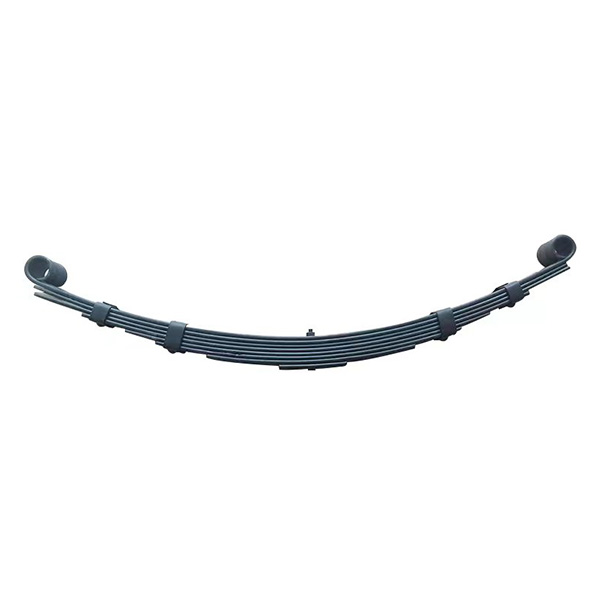
A leaf spring is a slender, curved suspension component made from several flat strips of spring steel stacked together. The longest strip (the master leaf) sits on top and defines the overall length and arch, while progressively shorter leaves sit beneath it. The stack is held tightly at the center by a central bolt and clamped along its length so the leaves act as a single unit. The two ends connect to the vehicle frame or axle through eyes (circular loops) or through shackles and hangers.
Unlike coil springs that compress vertically, a leaf spring flexes and flattens under load, storing energy in its curved steel leaves. That elegant simplicity is exactly why it has survived more than a century of engineering competition.
"A well-made leaf spring does three jobs at once — it supports the load, absorbs the shock, and locates the axle. Very few components can claim that versatility." — Haoye Suspension Engineering Team
The Leaf Spring Working Principle
The leaf spring working principle is rooted in elastic deformation. When a wheel hits a bump or the vehicle carries cargo, vertical force pushes the axle toward the frame. This compresses the arch of the spring, forcing the steel leaves to flex and flatten. Because spring steel stores mechanical energy, the leaves push back, returning the axle toward its resting position and smoothing out the road input before it reaches the chassis.
Several physical effects happen at once:
Load distribution: Multiple leaves share the bending stress, spreading weight across a wider area than a single bar could.
Shock absorption: Elastic flex converts sudden impacts into gradual, controlled movement.
Axle location: The fixed center and eyes keep the axle positioned, providing a guiding function so wheels track predictably.
Friction damping: Minor friction between leaves adds natural damping that reduces oscillation.
When the load is removed, the leaves spring back to their original camber. This reversible flexing is what makes the component durable across millions of load cycles.
Main Components of a Leaf Spring
Understanding the parts helps you specify, inspect, and maintain the right assembly:
| Component | Function |
|---|---|
| Master (top) leaf | The longest leaf with formed eyes at both ends; sets length and arch. |
| Graduated leaves | Shorter leaves beneath the master that share load and add capacity. |
| Center bolt | Holds the leaf pack aligned at the midpoint and locates it on the axle. |
| U-bolts / clips | Secure the pack to the axle seat and prevent side shift. |
| Eyes & bushings | Connection points to frame or shackle; bushings reduce noise and wear. |
| Shackles | Allow the spring to lengthen as it flattens, maintaining consistent ride height. |
Types of Leaf Springs You Will Encounter
Not every leaf spring looks the same. The three most common variants match different mounting needs:
Double eye leaf spring: Eyes at both ends, mounted to fixed hangers or a hanger plus shackle. The most popular style for trailers and light trucks.
Single eye leaf spring: One eye at the front and a flat or slipper end at the rear that slides in a hanger. Common on smaller trailers and torsion-compatible setups.
Special / custom leaf spring: Non-standard arch, width, or eye geometry built from samples or drawings for unique axles and agricultural or industrial equipment.
"Choosing between a double eye and single eye leaf spring is less about performance and more about how your hanger geometry is laid out. Measure first, then match." — Haoye Product Specialist
Why Leaf Springs Still Dominate Heavy-Duty Suspension
Coil and air springs get the headlines, but the suspension leaf spring keeps winning in commercial, agricultural, and trailer sectors for five solid reasons:
High load capacity: Stacking leaves lets you scale capacity simply by adding plates.
Low cost: Fewer parts, easier manufacturing, and cheap replacement leaves.
Durability: No sealed chambers to leak; damage is often repairable by replacing one leaf.
Built-in axle location: Reduces the need for separate trailing arms or links.
Predictable behavior: Linear, well-understood spring rate that fleets can plan around.
Leaf Spring Applications Across Industries
You will find leaf springs everywhere weight and reliability matter:
Trailers: Boat, utility, cargo, and horse trailers rely on trailer leaf spring sets for stable towing.
Trucks & vans: Light commercial vehicles use them for payload-rated rear suspension.
Agriculture: Seeders, trailers, and implements benefit from rugged, repairable springs.
Off-highway: Forestry, mining, and construction equipment use heavy multi-leaf packs.
Motorcycles & specialty: Certain motorcycles and vintage restorations keep leaf systems alive.
"For a fleet manager, the best spring is the one that fails predictably and is cheap to fix at the roadside. Leaf springs win that test every time." — Haoye Field Service Note
Frequently Asked Questions
How long does a leaf spring last?
Typicalservice life ranges from 50,000 to 200,000 km depending on load, road conditions, and corrosion exposure. Regular lubrication and avoiding overload extend life significantly.
Can a broken leaf spring be repaired?
Often yes. A single cracked or broken leaf can be replaced without discarding the whole pack, which is one of the biggest advantages over sealed coil or air systems.
What steel is used in leaf springs?
Most are made from high-carbon spring steel such as 60Si2Mn or 51CrV4, heat-treated for high yield strength and fatigue resistance.
Do leaf springs need lubrication?
Yes. A graphite or moly-based lubricant between leaves reduces friction, noise, and premature wear, especially in wet or dusty environments.
How do I know the right leaf spring size?
Match eye-to-eye length, width, number of leaves, and arch to your axle rating and hanger geometry. Never guess — measure the old spring or the mounting points.
Are leaf springs better than coil springs?
For heavy, repairable, low-cost load carrying, leaf springs are better. Coils win on ride refinement for passenger cars. The right choice depends on the application.
Conclusion
The leaf spring is a masterclass in engineering simplicity: a stack of curved steel that supports massive loads, smooths rough roads, and keeps the axle located — all with minimal parts. Whether you run a single utility trailer or a national fleet, understanding how leaf springs work helps you buy smarter, maintain cheaper, and avoid costly roadside failures.
Work With a Direct Leaf Spring Manufacturer
Renqiu Haoye Motorcycle Parts Co., Ltd. produces double eye, single eye, and custom leaf spring assemblies with CNC-machined precision and factory-direct pricing. Send us your sample or drawing and our engineering team will match or improve your current specification. Visit Haoye Machinery to request a quote or discuss OEM supply.