

In the demanding world of trailer suspension, the integrity of a leaf spring pack determines the difference between a stable, level load and a dangerous sway at highway speed. A double eye leaf spring and a single eye leaf spring can look almost identical on a shelf, yet their eye geometry, mounting hardware and load behaviour are engineered for very different frames. By understanding how eye-to-eye length, arch and leaf count interact, trailer builders and fleet operators can specify a pack that carries its rated capacity without premature fatigue. As global light-trailer and utility-vehicle markets push toward higher payload efficiency and longer service intervals, choosing the correct eye configuration has become an engineering specification rather than a hardware-store guess.
1. What Is a Double Eye Leaf Spring?
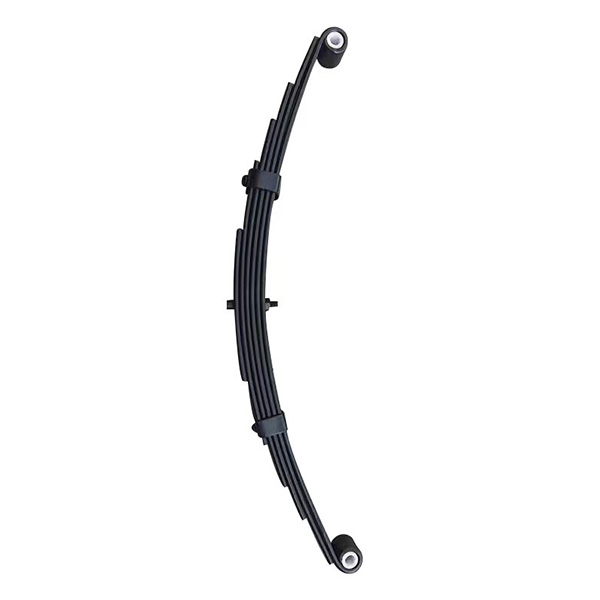
A double eye leaf spring is formed with a rolled eye at each end of the main leaf. Both eyes pivot on bolts that pass through the frame hanger at the front and a shackle at the rear. Because the spring is captured at both ends, it can only change length through the swing of the shackle, which gives the suspension a predictable, well-controlled axle path.
This is the configuration used on the overwhelming majority of single-axle utility trailers, boat trailers, cargo trailers and light commercial chassis. Its advantages are simple: the spring is easy to centre on the axle seat, the hardware is standardised, and the pack can be removed and replaced without modifying the frame.
Two rolled eyes, typically with a nylon or rubber bushing pressed in
Rear eye connects to a shackle that absorbs length change under deflection
Standard mounting hardware keeps replacement cost and downtime low
Available in multi-leaf packs and as custom double eye leaf spring series
2. What Is a Single Eye Leaf Spring?
A single eye leaf spring carries a rolled eye on one end only. The opposite end is a flat or slightly tapered leaf that slides inside a slipper hanger or rests on a wear pad. This layout is common on heavier equipment, agricultural implements and certain tandem-axle suspensions where the spring must be free to lengthen under load without a shackle.
Because the sliding end is not pinned, the spring's effective length changes as it flattens, which produces a mildly progressive rate. For a trailer that occasionally carries very uneven loads this can be an advantage, but it also means the slipper end needs periodic inspection for wear.
One rolled eye plus one slipper or flat end
Progressive rate as the spring flattens under load
Favoured on agricultural, off-road and heavy equipment running gear
Slipper pad and wear surface become routine inspection items
3. Key Differences That Affect Your Specification
Selecting between the two is rarely a matter of preference. It comes down to what the frame was built to accept, and how the axle is expected to behave under load.
| Criteria | Double Eye Leaf Spring | Single Eye Leaf Spring |
|---|---|---|
| Mounting | Fixed hanger + shackle at both ends | Fixed eye + slipper hanger |
| Rate behaviour | Essentially linear | Mildly progressive |
| Axle control | Strong lateral location | Depends on slipper condition |
| Replacement | Direct bolt-on, standard hardware | May require slipper inspection |
| Typical use | Utility, boat, cargo, light commercial | Agricultural, off-road, heavy equipment |
In both designs, the bushing is the wear item. A worn bushing lets the eye move on its bolt, which shifts the axle, wears the tyre and eventually cracks the eye itself. Replacing bushings during a spring change is inexpensive insurance.
4. How to Read a Leaf Spring Specification
A part number such as 8×45×700 is not a mystery: it encodes leaf width, thickness and the eye-to-eye (or overall) length in millimetres. Reading it correctly is the fastest way to cross-reference an existing pack.
Width (8) — the nominal width of the leaves in mm, which must match the axle seat and U-bolt spacing.
Thickness (45) — nominal stack or leaf thickness in mm, directly related to capacity and rate.
Length (700) — eye-to-eye or overall length, which must suit the hanger spacing and shackle angle.
Leaf count and arch — quoted separately; they set ride height and load capability.
Two springs with identical numbers but different arch will sit at different ride heights. Always confirm arch and capacity, not just the three printed dimensions, before approving a substitution.
5. Selecting the Right Pack for Your Trailer
Work from the load backwards. Establish the axle rating and the loaded tongue weight, then choose a pack whose capacity covers the real payload with margin. Under-specifying a spring is the single most common cause of sagging, bottoming-out and broken main leaves.
Match capacity to the loaded axle, not the empty trailer
Confirm eye diameter and bushing type against existing hardware
Choose hot-dip galvanised finish for boat, coastal or winter-salt service
Replace in axle pairs — a new spring beside a tired one pulls the trailer to one side
A direct leaf spring manufacturer can also supply the matching accessories — shackles, sleeves, connectors and U-bolt kits — so the whole suspension is replaced as a matched set rather than pieced together.
Frequently Asked Questions
Can I replace a double eye spring with a single eye spring?
Not without changing the hangers. The two designs need different frame hardware, so the practical answer is to replace like for like unless you are prepared to modify the suspension mounts.
How do I know which size my trailer needs?
Measure eye-to-eye length, leaf width and stack thickness on the existing spring, then count the leaves. A photograph plus those three numbers allows a manufacturer to identify the pack quickly.
Should leaf springs be replaced in pairs?
Yes. A fresh spring next to a fatigued one produces uneven ride height and axle alignment, which shows up as tyre wear and a trailer that pulls under braking.
How often should bushings be inspected?
At every suspension service, and at least once a season for trailers used on rough or unpaved ground. Bushings are far cheaper than the eye they protect.