

Loading a boat onto a trailer at a slippery ramp is a controlled operation, not a contest of strength. The hand winch is the component that makes it controlled: a geared drum, a strap and a ratchet that let one person pull several hundred kilograms up an incline smoothly and hold it there. Selecting between a 1200 lb hand winch and a 2500 lb unit is a matter of real load, ramp angle and duty cycle — not of buying the biggest number available. This guide explains how ratings are defined, why webbing has largely displaced cable on trailers, and what to check before each season.
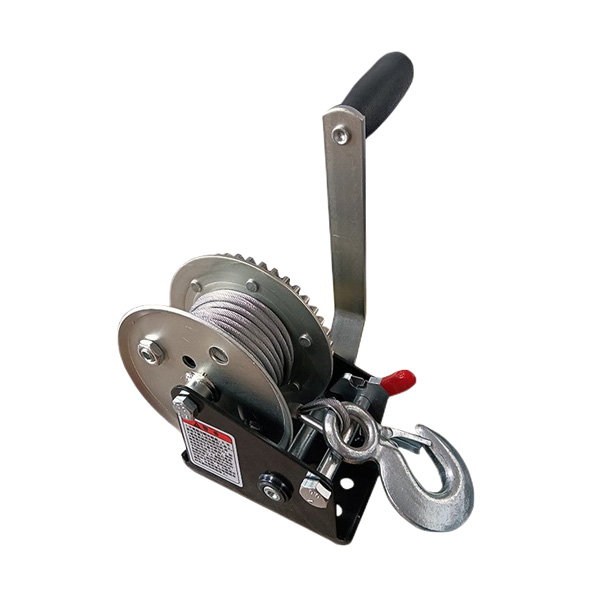
1. Reading a Winch Rating Correctly
A winch rating describes the load the unit is designed to pull under defined conditions — typically a straight, level pull on the first layer of strap on the drum. Real ramp conditions are harsher, because the boat must be pulled up an incline against gravity and residual water drag.
1200 lb hand winch — small dinghies, jet skis, light utility loads
1500 lb hand winch — small aluminium boats and general utility trailers
1600 lb hand winch — mid-size trailer boats with modest gear aboard
2000 lb hand winch — heavier hulls and equipment carriers
2500 lb hand winch — the top of the manual range, for heavy loads and steep ramps
The practical rule is to size for the worst realistic case — loaded boat, wet bunks, steep ramp — and keep margin. A winch working near its limit is hard to crank and wears quickly.
2. Webbing vs Cable: Why Strap Winches Dominate Trailers
A webbing hand winch uses a flat polyester strap instead of steel cable. On trailers this is now the default, and the reasons are practical rather than fashionable.
| Consideration | Webbing strap | Steel cable |
|---|---|---|
| Handling | Soft, no gloves needed | Burrs and broken wires |
| Safety on failure | Little stored energy | Recoil risk |
| Contact surfaces | Will not scratch hulls | Abrasive to gelcoat |
| Corrosion | Unaffected by salt water | Rusts, needs lubrication |
| Inspection | Visible wear and UV fading | Broken wires, often hidden |
Strap does have one enemy: ultraviolet light and abrasion. Rinsing with fresh water, storing out of direct sun and replacing a faded or frayed strap on schedule removes that weakness almost entirely.
3. Gear Ratio, Two-Speed and Crank Effort
Two winches with the same rating can feel very different to operate. Gear ratio determines how much effort each turn of the handle costs and how quickly the load comes in.
Single-speed — simplest and lightest, suited to smaller loads
Two-speed — a low gear for the final, heaviest pull and a high gear for take-up
High ratio — easier cranking, slower retrieval
Low ratio — faster retrieval, higher handle effort
Where the winch is used frequently, two-speed gearing earns its cost: the high gear removes slack quickly, and the low gear makes the last metre up the ramp controllable.
4. Mounting, Strap Routing and Hold-Down
Most winch failures on the water are installation failures. The mount takes the entire pulling load, so it must transfer that load into the trailer frame rather than into a thin cross-member.
Bolt through a reinforced winch post or a properly braced mounting plate
Keep the strap pulling in line with the boat's centre of gravity
Set the strap height so it does not rub on the bow eye or roller
Use a separate safety chain or tie-down for road transport — the winch is not a transport restraint
Confirm the ratchet fully engages and holds under load before releasing the handle
A strap that rubs against a sharp edge will fail long before its rated life. A cheap roller or edge protector prevents it.
5. Inspection and Replacement Intervals
Straps are consumables. The winch body will outlast several of them, so inspection should concentrate on the strap and the ratchet mechanism.
Replace straps showing cuts, fraying, stitching damage or significant fading
Check the ratchet pawl and spring for wear and full engagement
Keep the gear mechanism clean and lightly lubricated
Verify mounting bolts are tight and free of corrosion at each season start
Test under load in a controlled setting before the first trip of the year
Frequently Asked Questions
How do I know which rating my boat needs?
Estimate the loaded weight of the boat including fuel and gear, then account for ramp angle and wet-bunk drag. Choose a winch with clear margin above that figure rather than one that matches it exactly.
Can I use a hand winch as the only tie-down for road transport?
No. A separate safety chain or strap should always secure the load for road travel; the winch is a loading device.
How often should the webbing strap be replaced?
There is no fixed interval — replace on condition. Any cut, frayed edge, damaged stitching or noticeable UV fading is reason to fit a new strap.
Is a two-speed winch worth the extra cost?
If the winch is used weekly or with a heavier hull, yes. The low gear makes the final pull controllable and reduces operator strain.