

A trailer jack does two jobs that most owners never think about until one of them fails: it carries the tongue weight while the trailer is parked, and it lets one person move a loaded trailer by hand. Choosing the wrong pattern makes both jobs harder — a wheel that sinks into soft ground, insufficient lift travel to clear the hitch, or a base that will not stay put on a slope. This guide compares wheel jacks, flat base jacks and beach wheel designs, and explains how capacity, travel and mounting height should drive the decision.
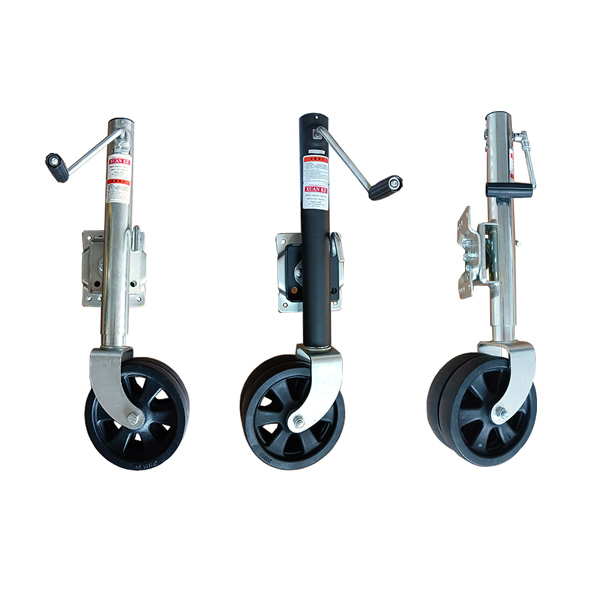
1. The Two Jobs: Lift and Manoeuvre
Every trailer jack must lift the tongue load high enough to clear the tow ball, and it must do so repeatedly without excessive handle effort. The second job — rolling a parked trailer into position — is what separates a wheel jack from a fixed-foot design.
Lift the tongue load clear of the hitch with reserve travel
Hold the trailer level and stable while parked
Allow repositioning by hand on firm surfaces
Resist sinking or slipping on soft or uneven ground
Survive outdoor storage without seizing
Before specifying a jack, measure the tongue weight loaded. Jack capacity is quoted against that load, and the tongue weight of a loaded trailer is often far higher than owners assume.
2. Wheel Jack Sizes: 6, 8 and 10 Inch
Wheel diameter is a rolling-resistance decision. A small wheel is compact and adequate on smooth concrete; a large wheel rolls over gravel, grass and cracks without bogging.
| Type | Best on | Advantage | Limitation |
|---|---|---|---|
| 6-inch wheel jack | Concrete, asphalt, workshop floors | Compact, economical | Struggles on gravel and soft ground |
| 8-inch wheel jack | Mixed surfaces, most general use | Best all-round compromise | Larger footprint when retracted |
| 10-inch wheel jack | Gravel, grass, uneven ground | Rolls easily over obstacles | Taller mounting requirement |
Where ground conditions vary, the 8-inch wheel jack is the usual default: it handles a gravel driveway without the mounting height that a 10-inch wheel demands.
3. Flat Base, Beach Wheel and Special Patterns
Soft ground is the enemy of any wheel. Two design responses cover most situations.
Flat base jack — a wide foot spreads the load, so the jack will not sink into sand, soft soil or hot asphalt. Ideal where the trailer stays put for long periods.
Beach wheel jack — a wide, low-pressure wheel designed for sand and loose surfaces, combining some mobility with flotation.
Australian style top crank wheel jack — a side or top crank layout with a heavy-duty swivel bracket, widely used where the trailer is regularly manoeuvred by hand and the jack swings up out of the way for travel.
Where a trailer is launched on sand or stored on grass, a flat base or beach wheel design prevents the frustrating sight of a jack slowly disappearing into the ground under load.
4. Capacity, Travel and Mounting Height
Three numbers decide whether a jack will actually fit and work: static capacity, lift travel and the retracted mounting height.
Static capacity — must exceed the loaded tongue weight with margin.
Lift travel — enough to raise the coupler clear of the tow ball, plus reserve for uneven ground.
Retracted height — the jack body must clear the ground when the trailer is hitched and travelling.
Mounting pattern — bolt hole spacing and channel width must suit the trailer frame.
Handle type — top crank, side crank or swivel, chosen for available clearance.
Short travel is the most common complaint after purchase. It is worth measuring the height difference between the parked and hitched positions before ordering.
5. Corrosion Resistance and Service
Jacks live at the front of the trailer, where road spray, salt and water collect. Finish selection therefore has a direct effect on service life.
Choose galvanised or coated finishes for coastal and winter-road use
Rinse after saltwater launching and allow to dry
Keep the screw thread clean and lightly lubricated
Check the swivel bracket and mounting bolts for movement each season
Replace a bent or corroded jack rather than forcing it — a failure under tongue load is dangerous
Frequently Asked Questions
How much jack capacity do I need?
Base it on the loaded tongue weight, typically around ten percent of total trailer weight, and choose a capacity with comfortable margin above that figure.
Wheel jack or flat base for a boat trailer?
A beach wheel or flat base design suits sand and soft launching areas; a standard wheel jack is fine if the trailer is always moved on hard standing.
Why will my jack not lift high enough?
Insufficient lift travel for the coupling height. Check the retracted and extended dimensions against the height needed to clear the tow ball on level ground.
Can a jack be mounted to any trailer frame?
Only where the mounting pattern and channel width suit it. Confirm bolt spacing and frame dimensions before purchase, or specify a compatible mounting bracket.