

Most specification debates around single eye spring packs come down to a choice between rolled-eye end and slipper end. Both are legitimate, and neither is universally better. This article sets the two arrangements side by side against layout, material, fit-up and whole-life cost, so that the decision follows the duty rather than habit.
Rolled-eye end and slipper end solve different problems
The single eye leaf spring does not work in isolation. Its performance depends on the structure it joins, the mountings around it, the way the assembly moves under load, and the skill of the person fitting it. Reviewing the whole assembly, rather than the single component, is what separates a robust detail from a marginal one.
Fit-up tolerances are not a suggestion. Small deviations in eye bore, bush condition and rebound clip tension accumulate across an assembly, and what looks like a minor mismatch at one joint can pull the whole arrangement out of alignment. Checking each joint as it is made is faster than trying to correct the finished build.
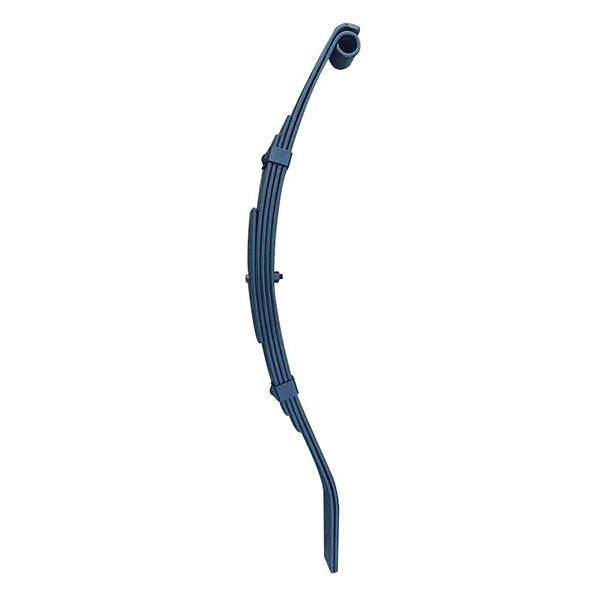
How layout decides the answer
| Criterion | rolled-eye end | slipper end |
|---|---|---|
| Layout | Needs a little more room around the joint | Fits a crowded assembly |
| Load path | Smoother transfer under steady duty | Handles compact installations |
| Material | silicon-manganese spring steel normally specified | chromium-manganese alloy spring steel where the environment demands it |
| Fit-up | More alignment checks before assembly | Faster to position on the bench |
| Inspection | eye bore, bush condition and rebound clip tension verified in two stages | eye bore, bush condition and rebound clip tension verified at final fit |
| Typical use | Common on tandem trailer bogies and agricultural running gear | Chosen where access is limited |
Movement under load deserves an explicit place in the review. A single eye leaf spring that is perfectly acceptable at rest can pick up significant force when the assembly is loaded and pushes against its restraints. Mounting points and restraints should be positioned deliberately, not simply wherever a bracket happens to fit.
- silicon-manganese spring steel — Consistent supply and straightforward inspection.
- chromium-manganese alloy spring steel — Better resistance to the environment, with a higher unit price.
- the rolled eye, the slipper end, the graduated leaves and the rebound clips — Check compatibility with the mating assembly, not just the part itself.
- slipper end — Used where space is tight or fit-up is simpler.
- eye bore, bush condition and rebound clip tension — Record the values that will be re-checked in service.
Silicon-manganese spring steel against chromium-manganese alloy spring steel
For tandem trailer bogies and agricultural running gear, a conservative selection with clear documentation tends to outperform a clever minimum-weight design. Fleet operators value a part that can be understood, inspected and replaced with the tools and skills already available in the workshop, especially during a short service window.
Cleanliness is easy to overlook on plain steel but critical on finished surfaces. Protecting the contact faces, keeping the bore free of debris, and capping open ends during assembly are simple habits that prevent damage which is otherwise discovered only at final fitting or commissioning.
A note on interchangeability
One useful habit is to walk the assembly before it is closed up and look for anything that will be inaccessible later. A single eye leaf spring positioned behind a panel or under a cover may be technically correct yet impossible to inspect, and that inaccessibility becomes a maintenance liability for the life of the vehicle.
What changes in fit-up
Field conditions rarely match the drawing exactly. Allowing a reasonable adjustment margin, keeping a small stock of the relevant single eye spring packs, and agreeing a clear change route before work starts all help a project absorb the unexpected without compromising the specification.
| Aspect | What to check | Why it matters |
|---|---|---|
| Material | silicon-manganese spring steel or chromium-manganese alloy spring steel matched to the duty | Compatibility and corrosion allowance |
| Dimensions | eye-to-centre length, free camber and slipper engagement | Determines fit-up without forcing the joint |
| Interface | Contact faces and bores as specified | Controls load transfer |
| Marking | Grade, size, heat number and maker | Traceability from goods-in |
| Inspection | eye bore, bush condition and rebound clip tension | Catches fit-up problems before they are buried |
| Documentation | Certificate, dimensional record, test report | Supports later maintenance |
Cost and availability compared
- rolled-eye end — Suits layouts where a smoother load path is available.
- slipper end — Used where space is tight or fit-up is simpler.
- silicon-manganese spring steel — Consistent supply and straightforward inspection.
- eye bore, bush condition and rebound clip tension — Record the values that will be re-checked in service.
- the rolled eye, the slipper end, the graduated leaves and the rebound clips — Check compatibility with the mating assembly, not just the part itself.
A clear, unambiguous specification helps everyone. State the grade, the governing dimensional standard, the interface geometry, the required inspection and the documentation, and leave the supplier in no doubt about which single eye leaf spring is expected. Ambiguity at this stage is the most common source of a costly re-order.
Reading the small print
Proof-load testing is a useful confirmation, not a substitute for good workmanship. An assembly that passes a proof load test can still be poorly aligned or over-stressed, so the test should close out a controlled process rather than compensate for a rushed one. That is why eye bore, bush condition and rebound clip tension belongs in the goods-in checklist, not only in the final inspection record.
A worked selection example
When neither option is right
Vibration is another quiet contributor to premature failure. Assemblies connected to rotating equipment carry a continuous low-amplitude load that a static design check will not capture. Adequate support spacing and a sensible clamp detail are usually enough to keep it under control.
Reading the trade-off in context
- ✓ Grade and heat number confirmed against the certificate
- ✓ eye-to-centre length, free camber and slipper engagement matches the approved duty specification
- ✓ eye bore, bush condition and rebound clip tension checked before parts reach the assembly area
- ✓ Contact faces protected and free of debris
- ✓ Mounting interface matches the order
- ✓ Inspection records filed against the build number